Mibu no Hanadaue, Japan’s Most Spectacular Rice Planting Ritual
Every year on the first Sunday of June, the rolling green hills north of Hiroshima city host one of the region’s most visually striking festivals. The Mibu no Hanadaue festival is a centuries-old ritual so beautiful, alive with music, color, and tradition, that UNESCO added it to its global heritage list of humanity’s greatest living treasures.
This elaborate agricultural ceremony has been performed by the Mibu and Kawahigashi communities of Kitahiroshima Town, as it has been (with some gaps) since medieval times. Today, the ritual reenactment is performed in a field kept specially in reserve to honor the rice deity and pray for an abundant harvest, and people come from far and wide to enjoy the spectacle.
The stars of Mibu no Hanadaue, Kazari-ushi
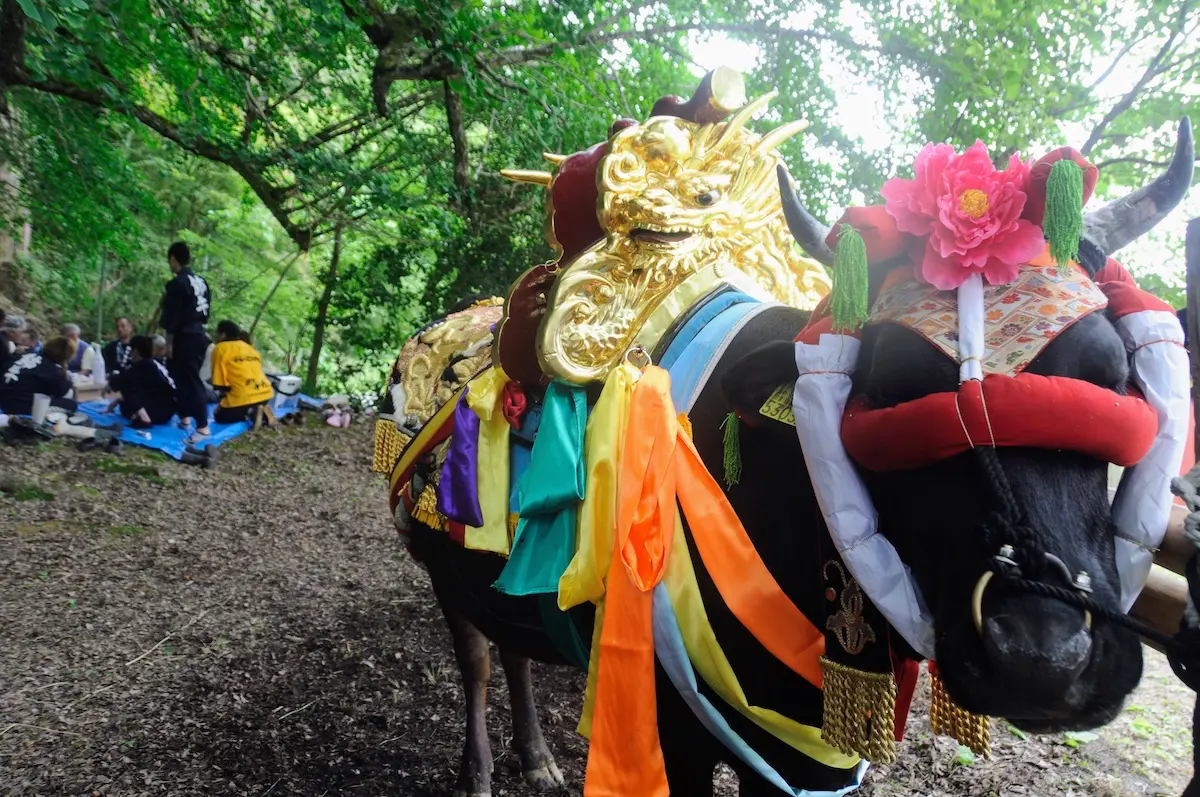
The stars of the show are undoubtedly the decorated cattle. Before anything happens in the fields, the kazari-ushi are brought by truck to the grounds of Mibu Hachiman Shrine, where they are transformed for their big day.
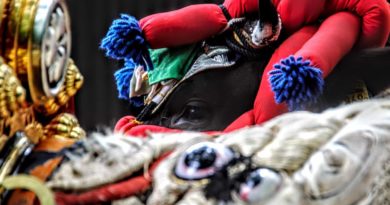
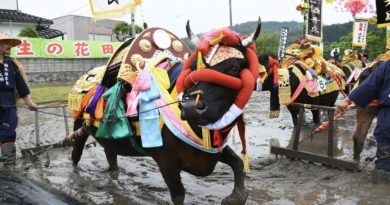
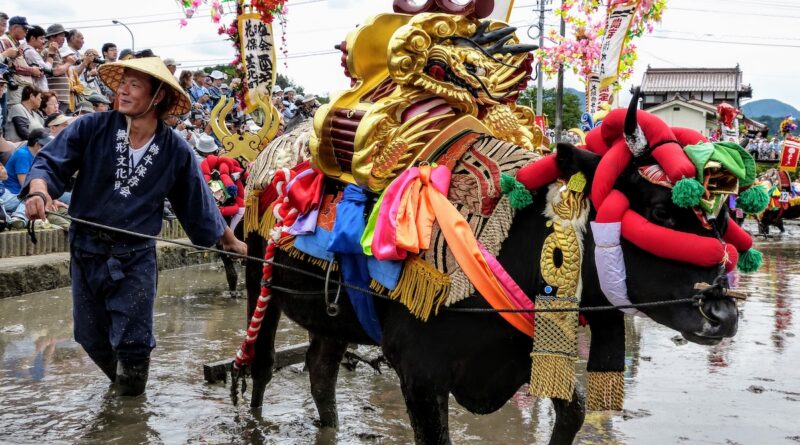
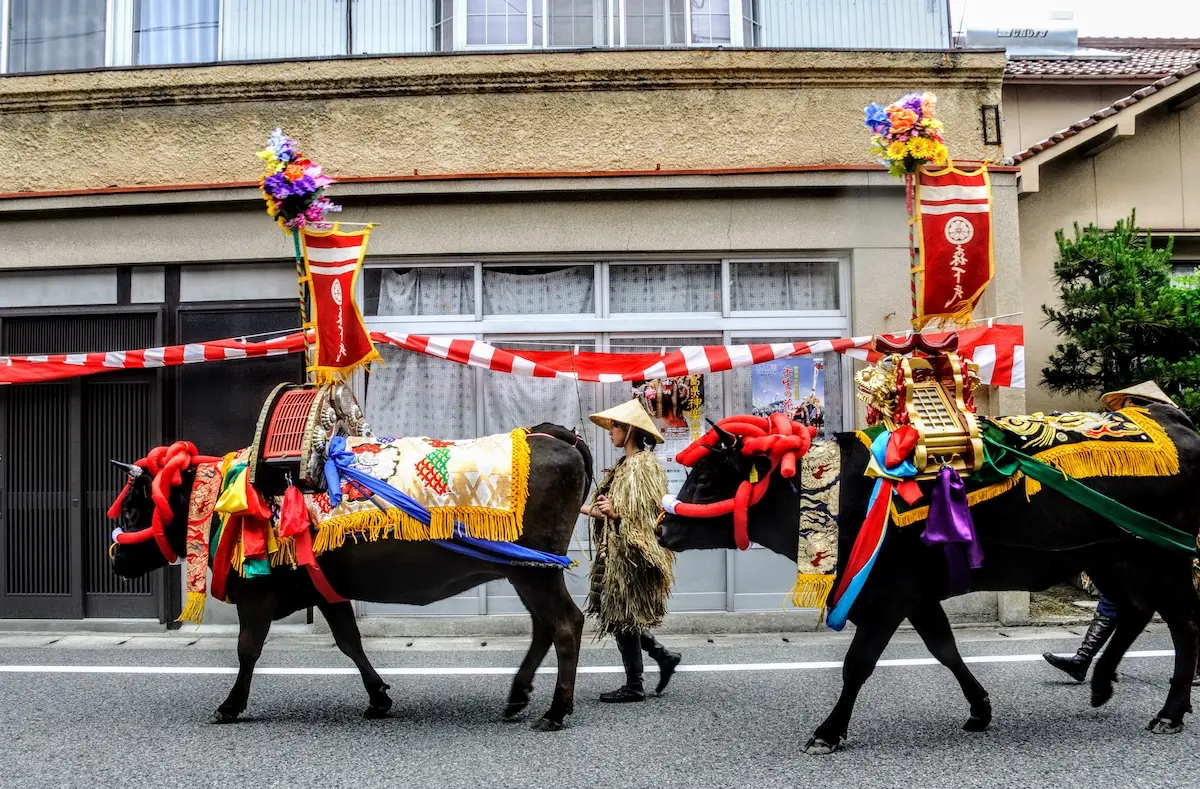
Only black-coated cattle that have been specifically trained to tolerate music, crowds, and the sensation of mud underfoot are chosen. Each animal is fitted with a magnificent hanagura — a flower saddle — wrought in gold brocade and adorned with elaborate artificial flowers, with the shapes of helmets and dragons worked into the design. Around their necks, they wear kubidama: soft red fabric bags stuffed with cotton that swing and jingle as they walk.
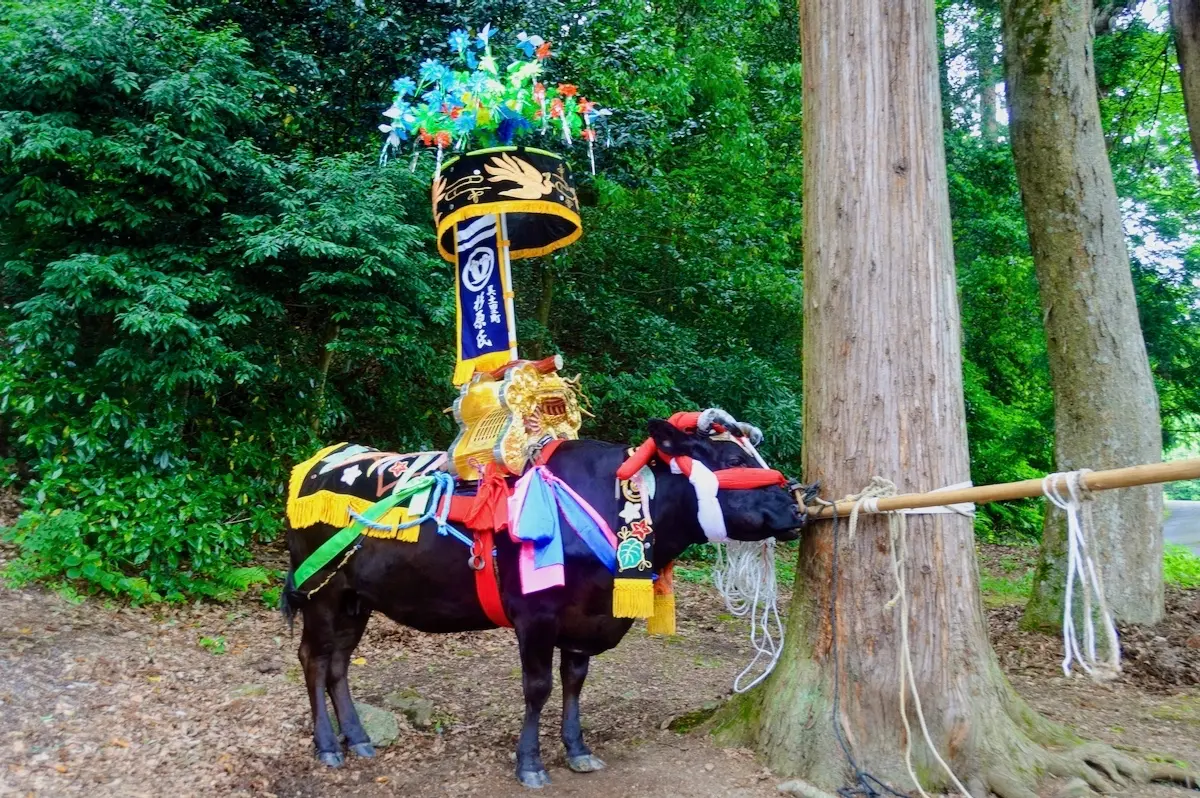
In earlier generations, more than twenty cattle from across this region would participate. Today, 12 to 13 animals are drawn from farms across Kitahiroshima Town, and neighboring Akitakata City — a dedicated Kazari-ushi Hozonkai (Decorated Cattle Preservation Society) maintains and trains the herd year-round, specifically to keep this important aspect of the ritual alive. The lead animal — called the omouji, or chief bull — carries special honor; the farm that selects it considers it a mark of great prestige.
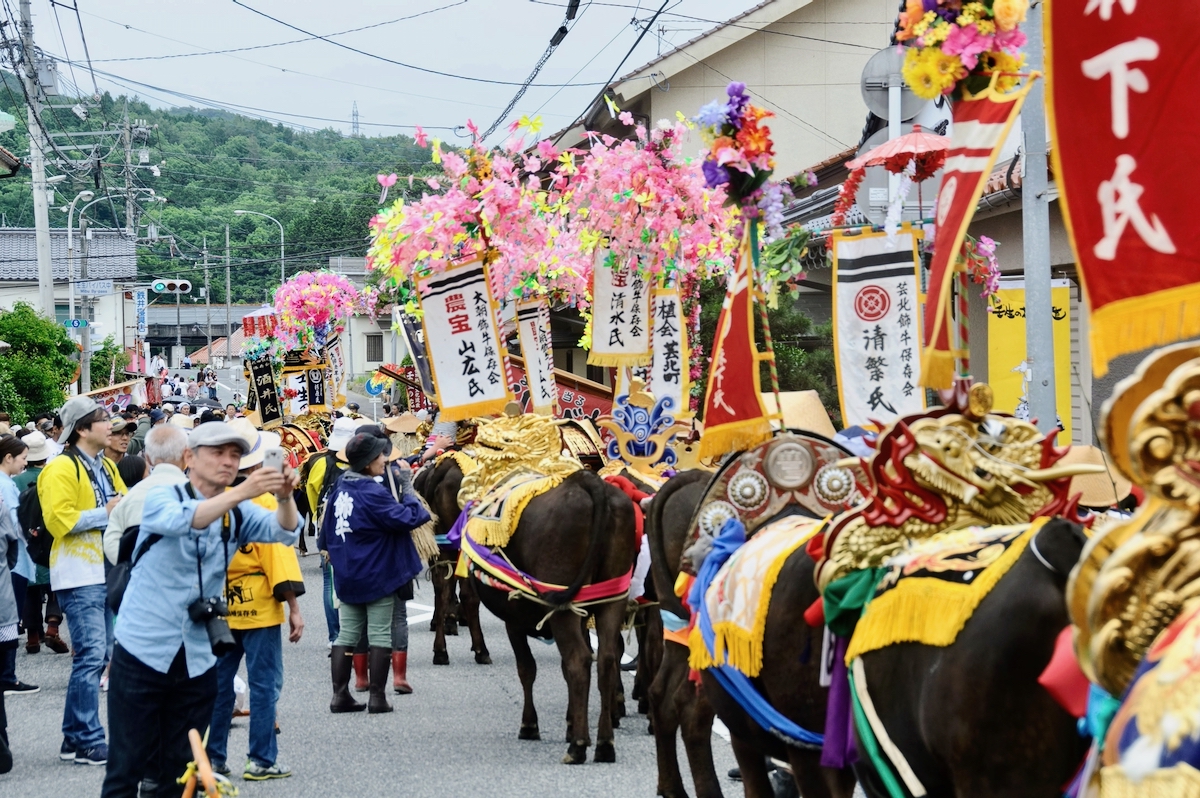
The procession of ten or more flower-crowned cattle winding through the local shopping street is one of the great sights of rural Hiroshima’s festival calendar, drawing crowds to the roadside before the planting commences.
The Sanbai, the sasara, music, and Saotome
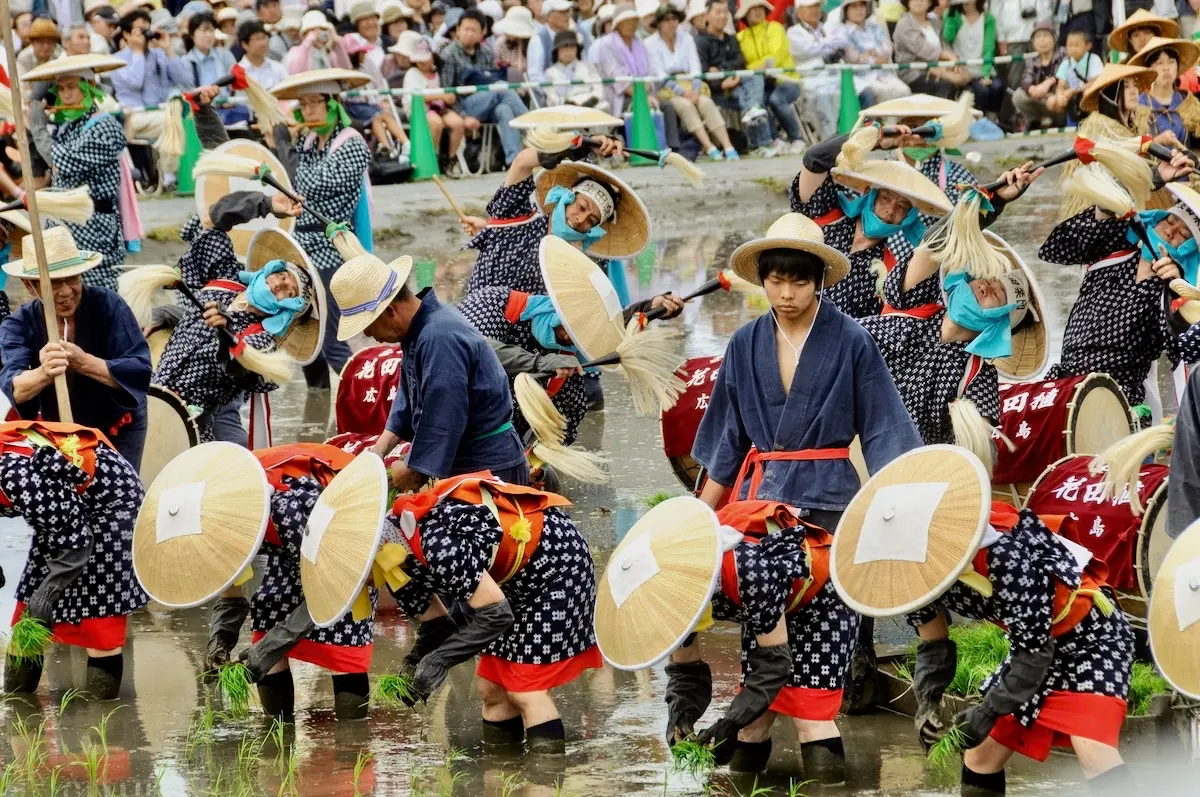
At the center of the planting is the Sanbai — the conductor of the ceremony, named for the rice deity itself (Sanbai is the local Geihoku term for Ta-no-Kami, the god of rice fields).
The Sanbai stands facing the line of Saotome, female rice planters dressed in traditional garb, each complete with a straw hat. He holds sasara: a percussion instrument made from soot-blackened split bamboo (susutake), carved with yin-yang markings. The Sanbai rubs the sasara pieces together to mark the rhythm and lead the call-and-response singing.
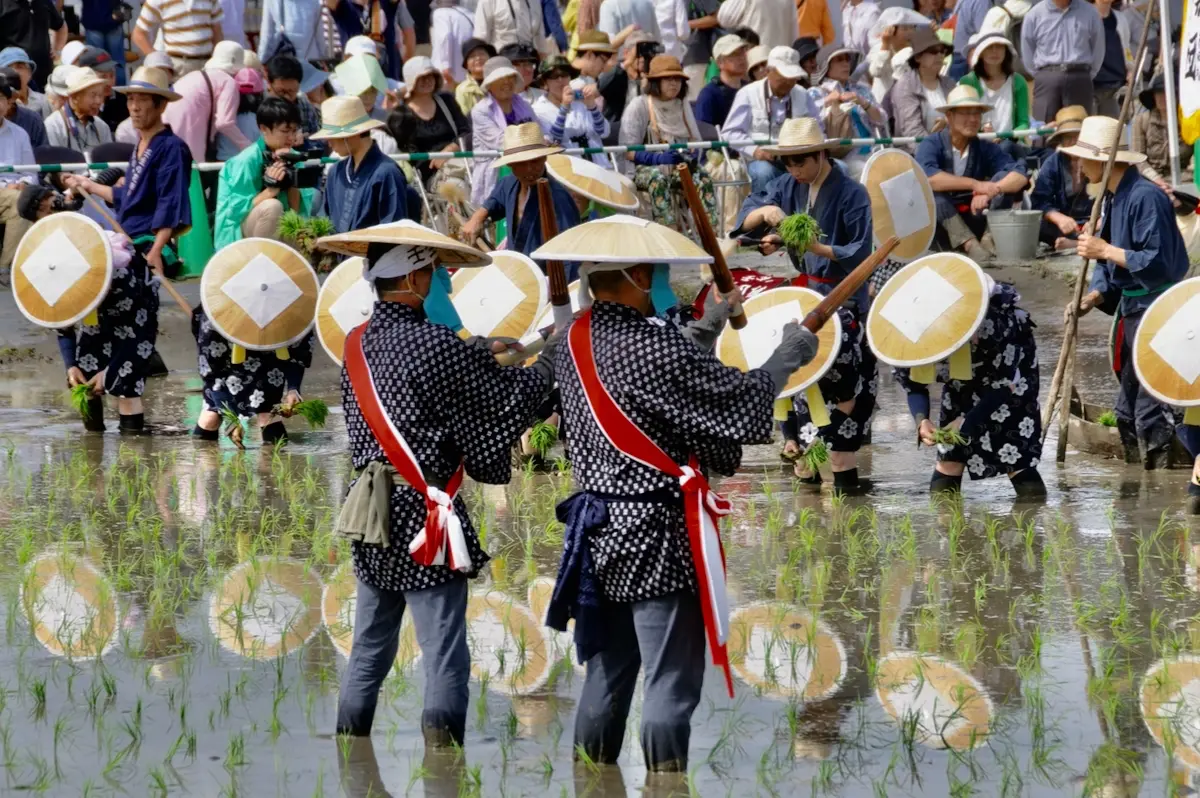
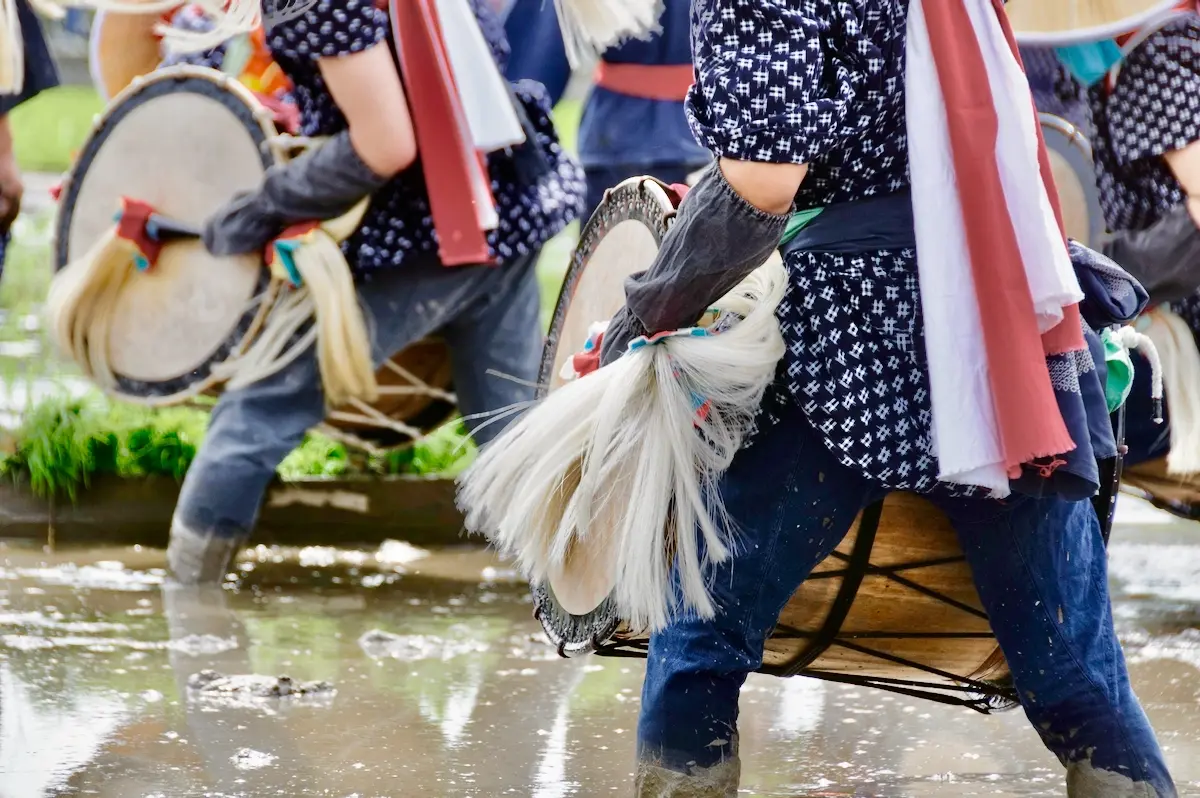
The full musical ensemble — large drum (odaiko), small drum (kodaiko), flute (fue), and hand-struck bell (teuchiganе) — plays throughout, following the lead of the Sanbai. The tradition is carried by two community traditional music groups: the Kawatoda Dengaku-dan and the Mibu Dengaku-dan.
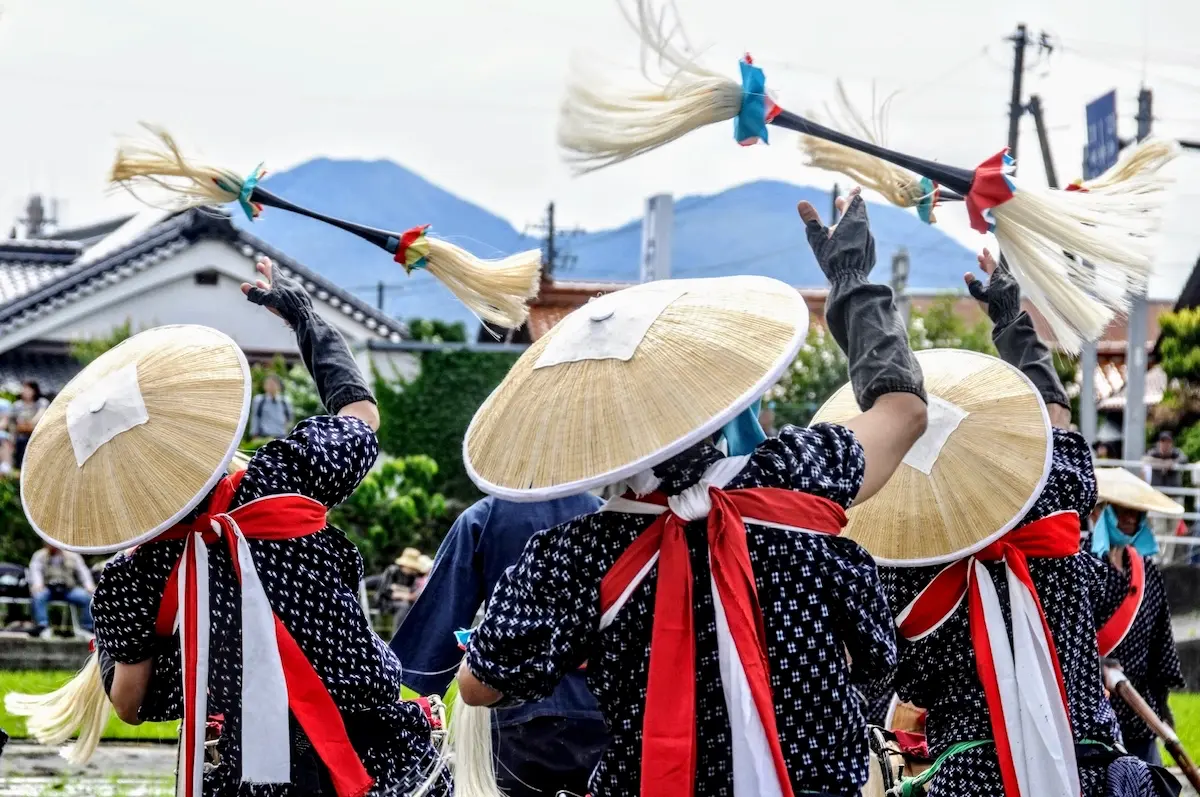
The sound is quite something, but so is the visual impression created by the rhythmic movements of the musicians, and the tossing of carefully choreographed tossing and catching drumsticks, all while the Saotome bob up and down as they plant the rice seedlings.
The ritual, step by step
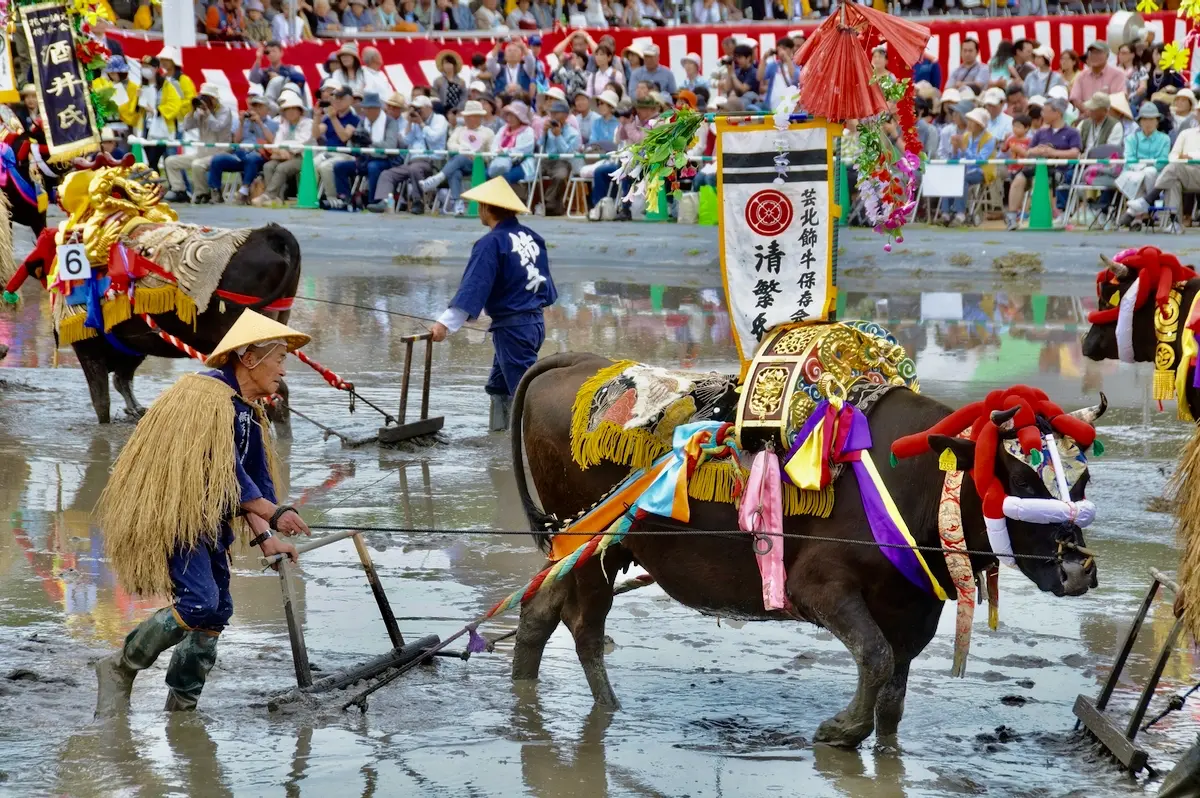
The day has a clear ritual structure, each stage connected to the next by music that never entirely stops. An announcer explains the meaning of each part in Japanese as it unfolds.
Black cattle are fitted with gold-brocade flower saddles and kubidama necklaces. Their horns and coats are polished for the occasion.
Decorated cattle, saotome maidens, the Sanbai conductor, and musicians from both dengaku orchestras parade through the shopping street to the ritual field.
Fitted with a mangwa (harrow), the cattle enter the flooded field in single file and till the paddy mud. Once done, the field is handed over to the humans.
The saotome collect seedlings while the Eburizuki levels the field with the eburi implement. The rice deity (Ta-no-Kami) is said to descend into the eburi at this moment.
The saotome line up facing the Sanbai conductor and plant seedlings walking backward along a guide rope. The Sanbai leads oya-uta (main songs) on his sasara rattles; the maidens respond with ko-uta (sub songs). A row of male musicians plays hayashi accompaniment behind them.
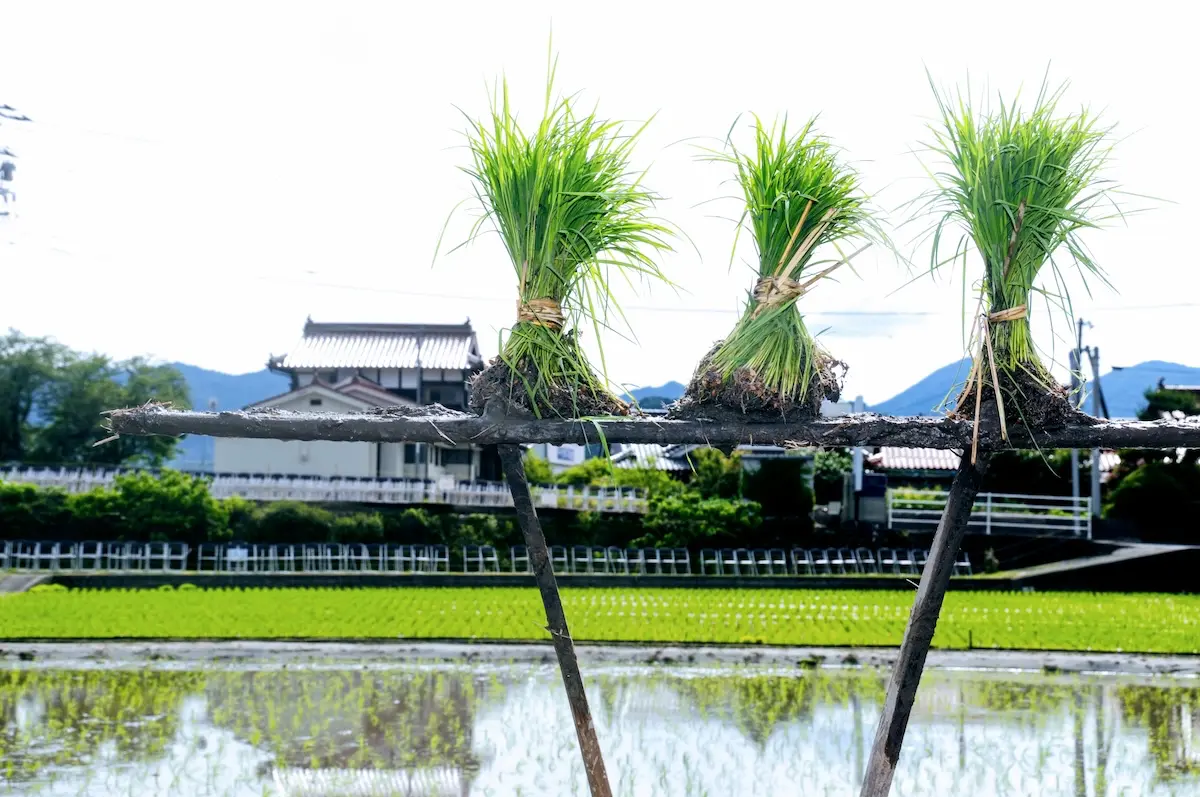
At the field’s water inlet, the eburi is tood upside down, stuck into the paddy, and three bundles of seedlings are placed on it. The rice deity is said to remain — or to return to the heavens by climbing it. It is an act of gratitude for the successful completion of the planting and a prayer for a bountiful harvest in the fall. The field is now complete.
A heritage, almost lost, thrives once again
The tradition of musically-accompanied communal rice planting — called hayashida or tabayashi across western Japan — traces its origins to at least the Heian period (794–1185), with similar ritual performances called dengaku recorded as early as that era. By the Kamakura period, it had become widespread.
In Mibu, the ceremony grew particularly grand because large local landowners would summon many participants to mark the end of planting on their fields, making it a community celebration as much as a spiritual one.
Like many such traditions, it faltered in the modern era, with periods when it was not held at all. Its revival and continuity are the result of dedicated preservation work by local community groups — the Mibu no Hana Taue Hozonkai (preservation society), the two dengaku orchestras, the decorated cattle society, and the town’s merchants and farmers.
Until the 1950s and 60s the event drew over two hundred participants and dozens of cattle from across the broader Geihoku region. Although, its scale is somewhat diminished, it remains the largest surviving hanadaue rice planting ritual in western Japan. The Japanese government designated the Mibu no Hanadaue as an Important Intangible Folk Cultural Property in 1976. After UNESCO added it to their Representative List in 2011, attendance in 2012 jumped from 7,000 to 15,000 people.
Kitahiroshima is also one of Japan’s leading rice-growing regions, cultivating some twenty varieties and earning top national rankings for rice quality — a fitting home for the country’s most celebrated rice-planting ceremony.
Visitor tips
- Head to Mibu Shrine early to watch the cattle being decorated at the shrine — horns polished, gold saddles fitted, kubidama necklaces adjusted
- Claim a roadside spot for the michiyuki procession before the crowds build
- Wear light, breathable clothing and sun protection — the field ceremony takes place under an open June sky all day
- Rubber-soled shoes you don’t mind getting muddy are sensible near the paddy edges
- Bring cash — stalls at the venue don’t always accept cards
- Stay for the closing eburi rite — most visitors leave after the planting, missing the ceremony’s quiet, moving finale
- Kagura performances are staged 09:00-11:00 at Koryu Center Murasaki no Sato (1,500 yen)
Getting there from Hiroshima
Access
Take the Miyoshi–Shobara–Matsue bound bus from Hiroshima Bus Center (platform 9) and alight at Chiyoda IC. Fare approx. ¥1,310 one way. Festival shuttles then run to the venue.
Take the Hamada-bound bus and alight at Chiyoda IC. Festival shuttle buses connect Chiyoda IC to the venue (approx. 09:00–16:00).
Approx. 40 km north of Hiroshima city; exit at Chiyoda IC on the Chugoku Expressway. Park at Chiyoda Michi-no-Eki or Kitahiroshima Town Hall, then take the shuttle to the ritual field.
A festival not to be missed
Japan has no shortage of beautiful festivals. But Kitahiroshima’s Mibu no Hana Taue – simultaneously a religious ceremony, a community gathering, an agricultural event, and a work of performance art – is certainly one to catch at least once if you have the opportunity.