


Foreign Worker Numbers in Hiroshima Reach Record High Amid Population Outflow
The number of foreign workers employed in Hiroshima Prefecture has reached a record high, highlighting the growing role overseas labor plays as the region faces population decline and labor shortages.
According to the latest figures released by the Hiroshima Labour Bureau, 51,821 foreign nationals were working in the prefecture as of the end of October 2025. This marks an increase of 3,470 people (7.2%) from the previous year and the highest total since reporting requirements were introduced in 2007.
The number of businesses employing foreign workers also hit a new high, with 7,121 workplaces reporting foreign employees — up by 461 (6.9%) year on year.
Vietnam, Philippines, and Indonesia Lead by Nationality
By nationality, Vietnamese workers remain the largest group, accounting for 15,468 people, or 29.8% of all foreign workers in Hiroshima. They are followed by workers from the Philippines (9,052 people, 17.5%) and Indonesia (7,515 people, 14.5%). Together, these three countries account for more than 60% of the foreign workforce in the prefecture.
While Vietnam remains the largest group overall, the fastest growth rates were seen among workers from Myanmar, Sri Lanka, and Indonesia, reflecting shifting migration patterns and increasing recruitment from Southeast and South Asia.
Breakdown of Foreign Workers by Nationality
| Nationality | Number of Workers | Share of Total |
|---|---|---|
| Vietnam | 15,468 | 29.8% |
| Philippines | 9,052 | 17.5% |
| Indonesia | 7,515 | 14.5% |
| China (incl. Hong Kong & Macao) | 6,228 | 12.0% |
| Nepal | 2,869 | 5.5% |
| Myanmar | 2,779 | 5.4% |
| Thailand | 1,465 | 2.8% |
| Brazil | 1,260 | 2.4% |
| G7 countries | 895 | 1.7% |
| South Korea | 645 | 1.2% |
| Peru | 389 | 0.8% |
| Sri Lanka | 387 | 0.7% |
| India | 354 | 0.7% |
| Other | 2,515 | 4.9% |
| Total | 51,821 | 100.0% |
Manufacturing Dominates Foreign Employment
Foreign workers are most heavily concentrated in manufacturing, which employs 22,471 people, or 43.4% of all foreign workers in Hiroshima. Other major sectors include wholesale and retail, construction, services, healthcare and welfare, and hospitality and food services.
The data also shows that small businesses play a central role. Nearly two-thirds of workplaces employing foreign workers have fewer than 30 employees, underscoring how critical overseas labor has become for smaller firms and regional employers.
Breakdown of Foreign Workers by Industry
| Industry | Number of Workers | Share of Total |
|---|---|---|
| Manufacturing | 22,471 | 43.4% |
| Wholesale & Retail | 6,943 | 13.4% |
| Construction | 4,892 | 9.4% |
| Services (not elsewhere classified) | 3,985 | 7.7% |
| Medical & Welfare | 3,208 | 6.2% |
| Accommodation & Food Services | 3,185 | 6.1% |
| Agriculture, Forestry & Fisheries | 2,239 | 4.3% |
| Education & Learning Support | 1,513 | 2.9% |
| Transportation & Postal Services | 1,111 | 2.1% |
| Information & Communications | 219 | 0.4% |
| Other | 2,055 | 4.1% |
| Total | 51,821 | 100.0% |
Shift Toward Skilled and Long-Term Employment
By visa status, the largest group remains workers under the Technical Intern Training Program, totaling 19,369 people (37.4%). However, the most notable growth was seen among holders of professional and technical visas, which increased by 22.1% to 15,240 people.
Within this category, the number of workers under the Specified Skilled Worker system rose sharply, reflecting national policy efforts to address labor shortages by encouraging longer-term and higher-skill employment.
Breakdown of Foreign Workers by Visa Status
| Visa Status | Number of Workers | Share of Total |
|---|---|---|
| Technical Intern Training | 19,369 | 37.4% |
| Professional / Technical Visas | 15,240 | 29.4% |
| Status-based Residence* | 9,055 | 17.5% |
| Student / Other Activities (part-time work) | 6,253 | 12.1% |
| Designated Activities | 1,904 | 3.7% |
| Total | 51,821 | 100.0% |
*Includes permanent residents, spouses of Japanese nationals, and long-term residents.
What Does This Mean for Hiroshima?
Hiroshima’s record-high number of foreign workers reflects deeper demographic challenges facing the prefecture.
In recent years, Hiroshima has experienced net population outflow (転出超過), particularly among younger Japanese residents moving to major metropolitan areas such as Tokyo and Osaka for education and employment. In fact, it has had the largest net outflow of all Japan’s prefectures for the past 5 years (9,921 people in 2025). This trend has intensified labor shortages across a wide range of industries.
Foreign workers are increasingly filling these gaps. Manufacturing, construction, healthcare, nursing care, and food services, all sectors essential to daily life and regional economies, now depend heavily on overseas labor. At the same time, the rapid growth in skilled and technical visa holders suggests a shift away from purely short-term labor toward longer-term employment and integration.
As population decline and out-migration continue, foreign workers are expected to play an increasingly central role in sustaining Hiroshima’s economy and maintaining local services, particularly in smaller cities and rural areas.
Foreign Workers in Hiroshima Prefecture by Nationality and Status of Residence (Oct 2025)
Click data table to view
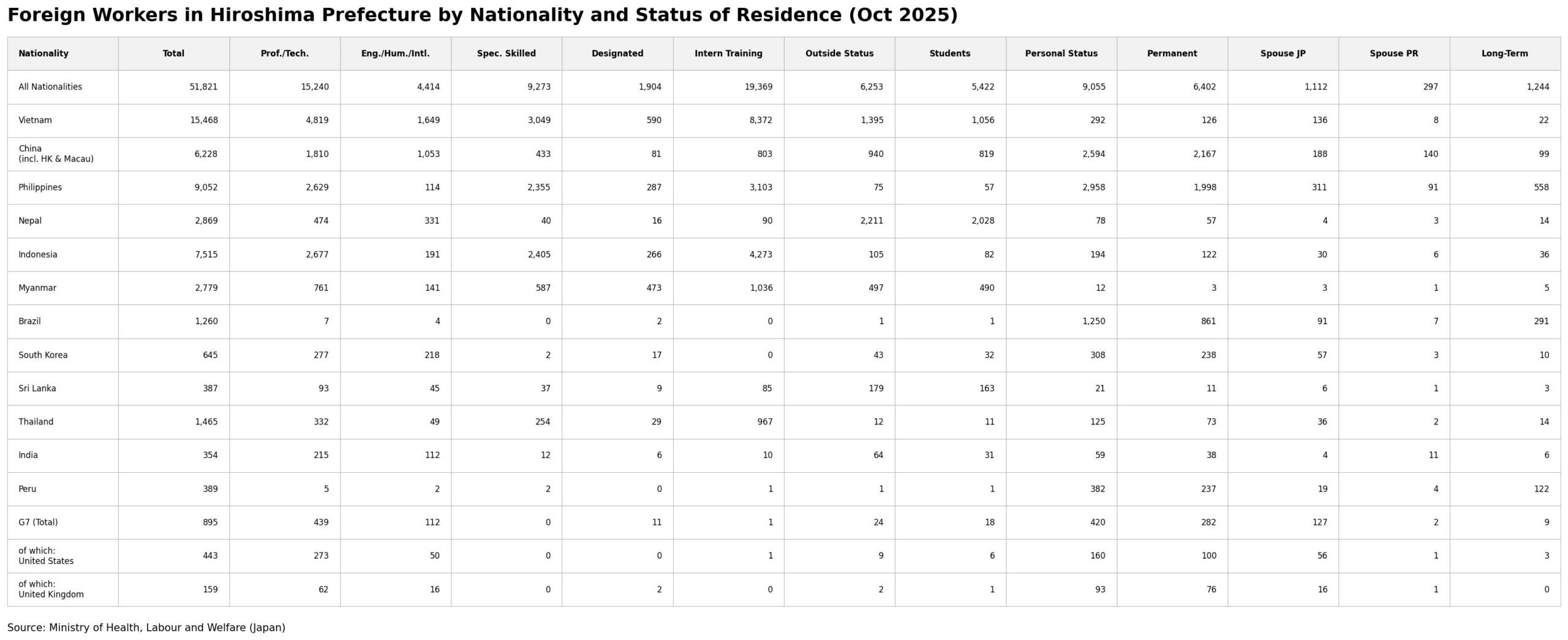
All figures from the Hiroshima Labour Bureau Summary of Reporting Status for ‘Employment of Foreign Nationals’ (January 30, 2026)
See the full report (in Japanese) here [PDF link].